Game Boy (1989)
How a small grey console changed the relationship between video games and culture for good.
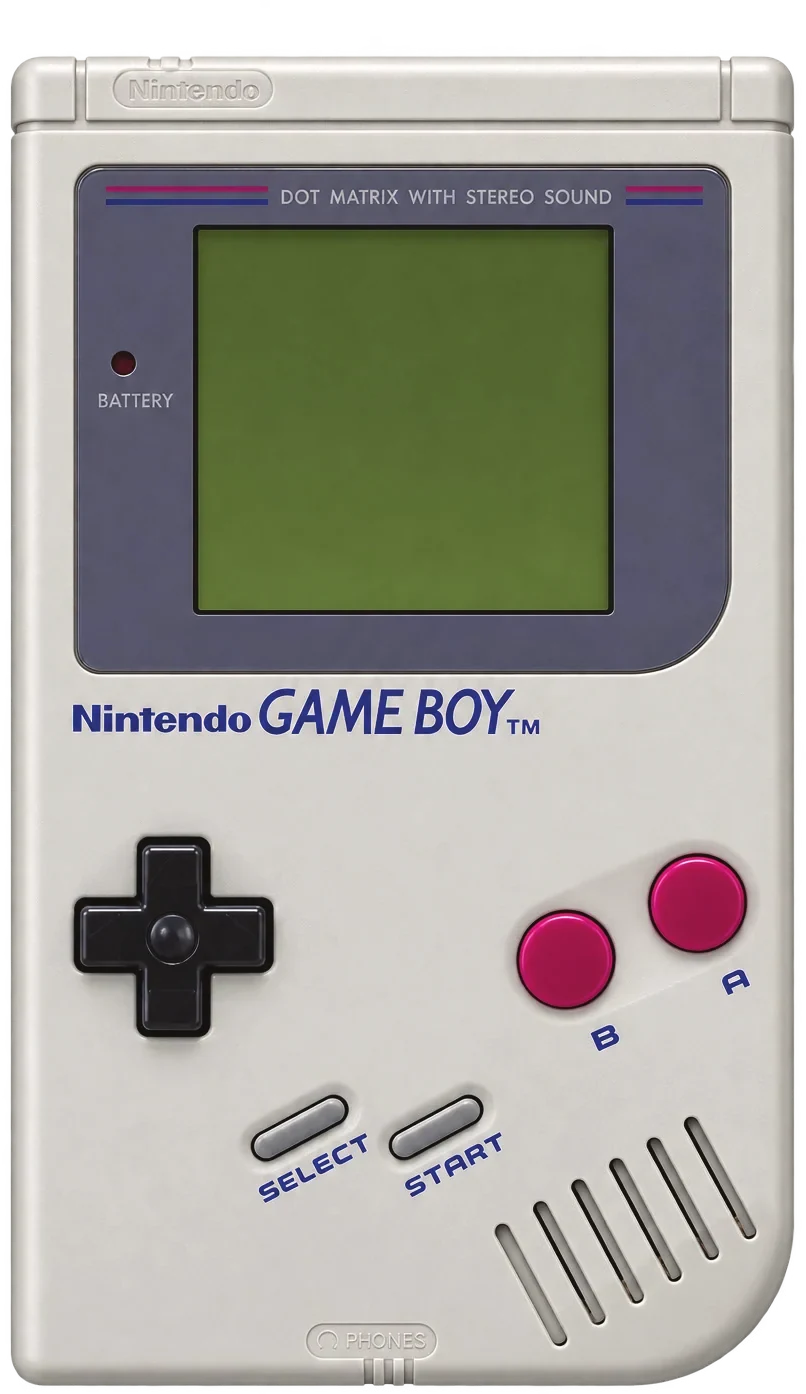
On 21 April 1989, Nintendo released a grey console the size of a paperback in Japan. It cost 12,500 yen, ran on four AA batteries and had a greenish 160 × 144-pixel screen with four shades. On paper it was less powerful than almost anything else around. In practice, it was the console that put video games in everyone’s pocket.
Yesterday’s technology, new ideas
It was designed by Nintendo R&D1, Gunpei Yokoi’s team, with Satoru Okada as deputy director. Yokoi believed in using mature, cheap technology in new ways, and the Game Boy is the best proof: a colourless screen in exchange for around 30 hours of play on four batteries, an affordable price and a device that could take a beating. Okada pushed for cartridges and developed the Link Cable, the lead that connects two consoles.
Tetris changed everything
In North America and Europe, the Game Boy came with Tetris. Not in Japan, where it was sold separately from 14 June 1989. The pairing worked like no other. Tetris for Game Boy sold more than 35 million copies, and the block game became the gateway to video games for people who had never touched a controller.
It reached the United States on 31 July 1989 and Europe on 28 September 1990. In Spain, official distribution by Erbe Software began in January 1991, at 18,900 pesetas.
A colourless screen, four batteries and one idea: play anywhere.
The one that survived a war
Few consoles have a story like this. The Game Boy belonging to Stephan Scoggins, a doctor during the Gulf War, was burned in a bombing and kept working. Nintendo displayed it for years at its New York store, switched on and running Tetris, until it was withdrawn in June 2023.
A second life with Pokémon
Seven years later, when its cycle seemed over, Game Freak released Pokémon Red and Green in Japan on 27 February 1996. Completing the Pokédex meant trading creatures with another console over the Link Cable, and that 1989 cable became the centre of a whole generation. In the West they came out as Red and Blue, and sold more than 31 million copies.
Why it matters
According to Nintendo, as of 30 June 2026 the Game Boy and Game Boy Color have sold 118.69 million units combined. But its legacy isn’t a number: it’s the idea that a video game can come with you on the bus, at break time or in the back seat of the car. Almost every handheld that followed, including the Playdate in this edition, owes something to it.
Sources