MUVIC: keeping everyone’s childhood
The Museu del Videojoc de Catalunya looks after the consoles, computers and cartridges that were the childhood of several generations. And it keeps a gem: the Overkal, the first European console, made here.
What a console brings back
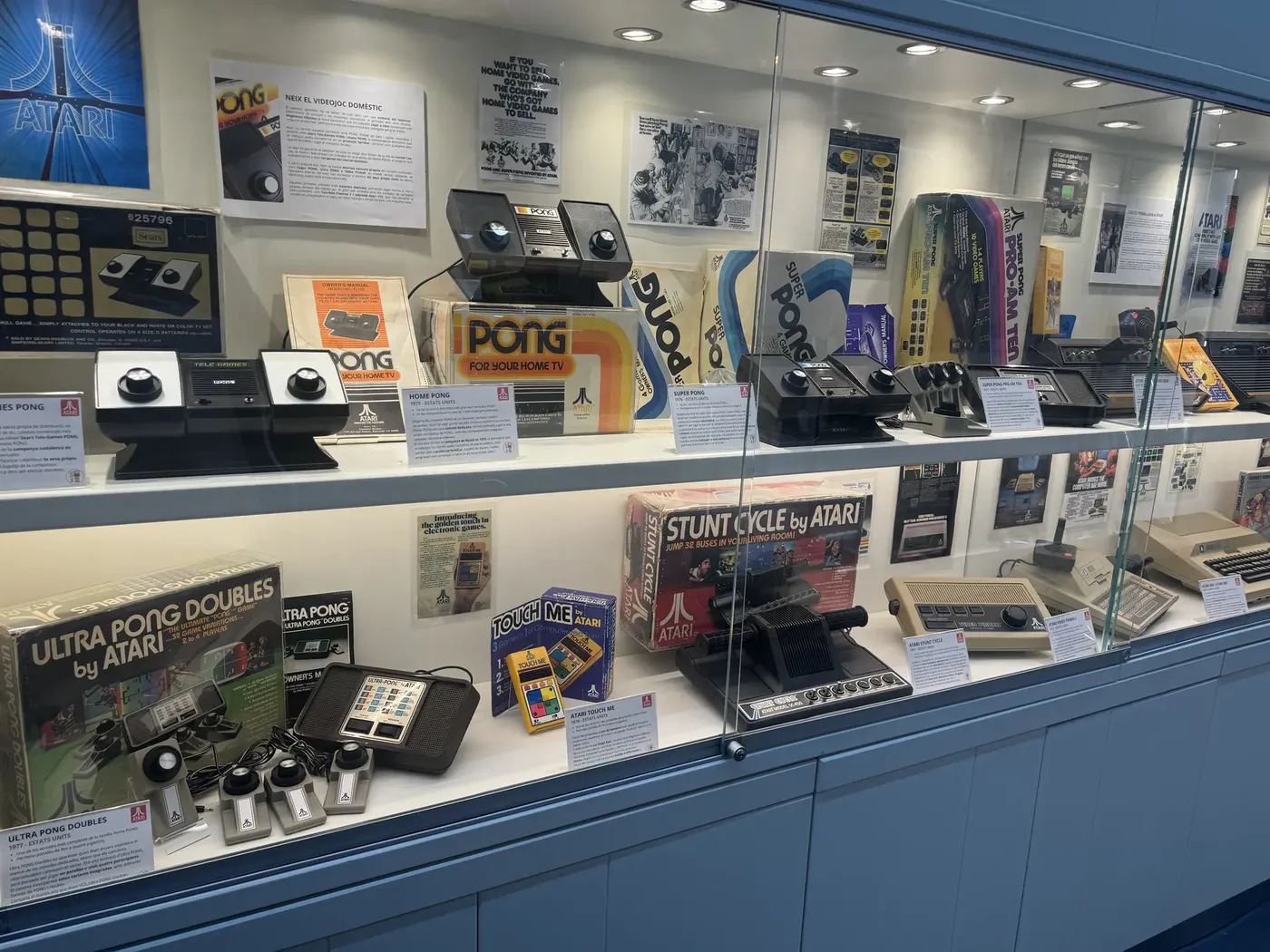
Some pieces aren’t worth what they cost, but what they bring back. The Museu del Videojoc de Catalunya, MUVIC, exists to look after them: consoles, computers, cartridges and magazines that were the childhood of several generations. Its mission fits in one line: “To preserve, study and share the international history of video games.”
Since January 2026 it has had a permanent exhibition space at SuperBoniato Store, a retro shop on Pérez Galdós street in Gràcia. Entry is free and the selection changes every two or three months, so there’s always a reason to go back.
And it goes out to find people wherever they play: RetroBarcelona, the UOC, SAGA Barcelona Game Fest. At SAGA it set up its museum in Espai 9, by the entrance. That’s where we met its president, Eduard Tornero.
The Overkal
The piece that best explains MUVIC is a console almost nobody knows: the Overkal.
“The first European video game console was built in Catalonia. It’s called the Overkal and we have it on display.” Eduard Tornero
To understand it you have to go back to 1972, when Ralph Baer and Magnavox released the Odyssey, the first home console in history. A year later, in Barcelona, someone made their own version.
It was an Odyssey clone. It used no cartridges: games were chosen with buttons, and plastic overlays were stuck on the TV screen, held in place by static electricity. It had seven types of game, with tennis as the star.
It cost 9,000 pesetas, was advertised as the TV’s “third channel” and was sold in instalments by mail order and in shopping arcades. It is believed to date from 1973 and is attributed to Inter Electrónica, a Barcelona company absorbed by Grundig in 1978. Nobody knows how many were sold.
Why keep them
An old console isn’t just plastic and circuits. It’s the afternoon someone unboxed their first machine, the cartridge lent to a friend, the title screen we still know by heart. When a piece is lost, a little of all that is lost too.
That’s why MUVIC doesn’t just collect. Each piece is documented, restored when needed and explained, so that whoever looks at it understands where it comes from and what it meant. That’s the difference between a cabinet full of objects and a museum: care for the history behind them.
And there’s something no book can replace: holding the controller again. At its exhibitions, whenever possible, the machines can be played.
A collection that’s shared
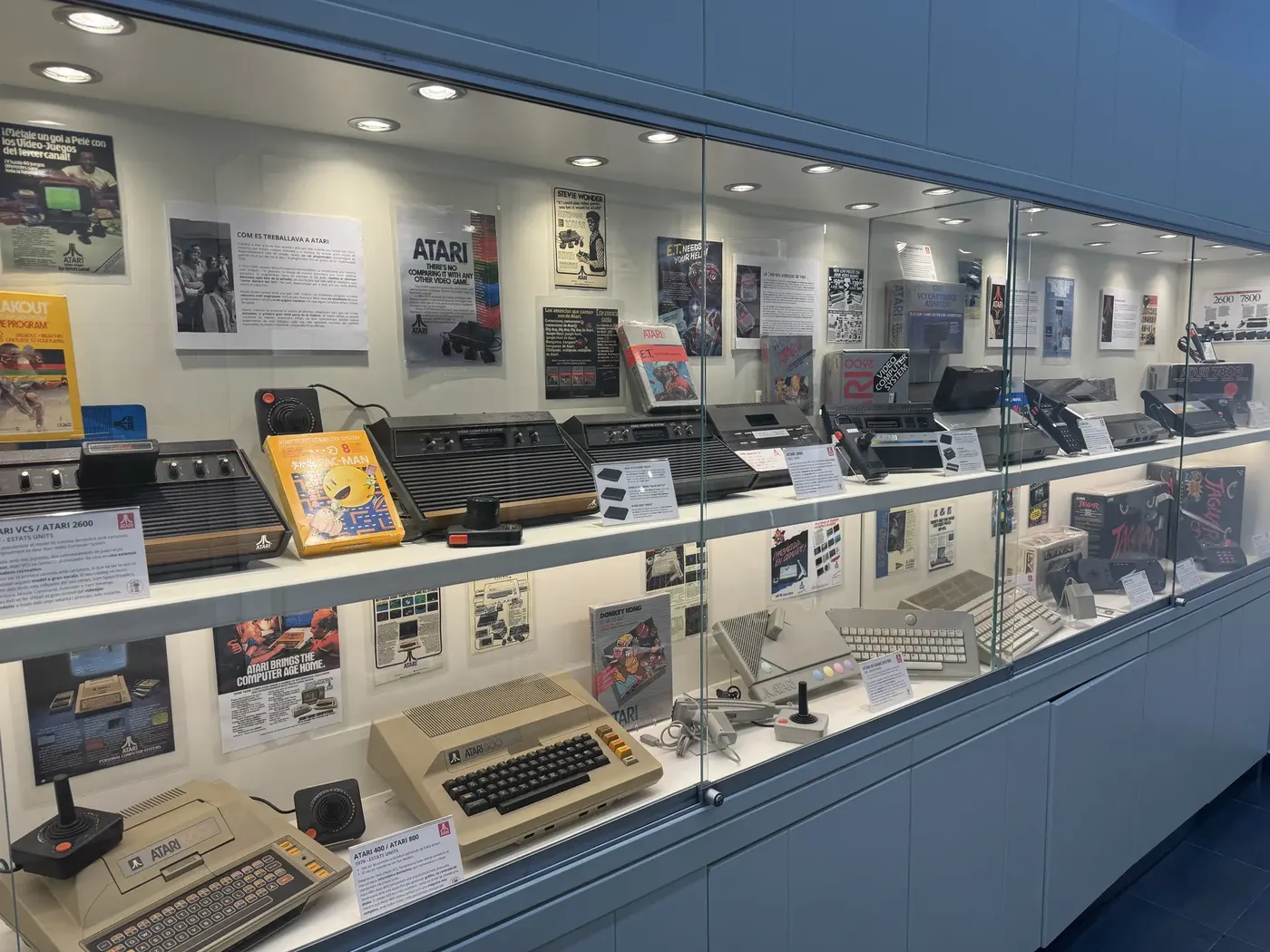
The museum also goes out to find new audiences. This year it has welcomed pupils from Benviure school in Sant Boi de Llobregat and people from the organisation ARAPDIS. In February it began working with the European Pixel League.
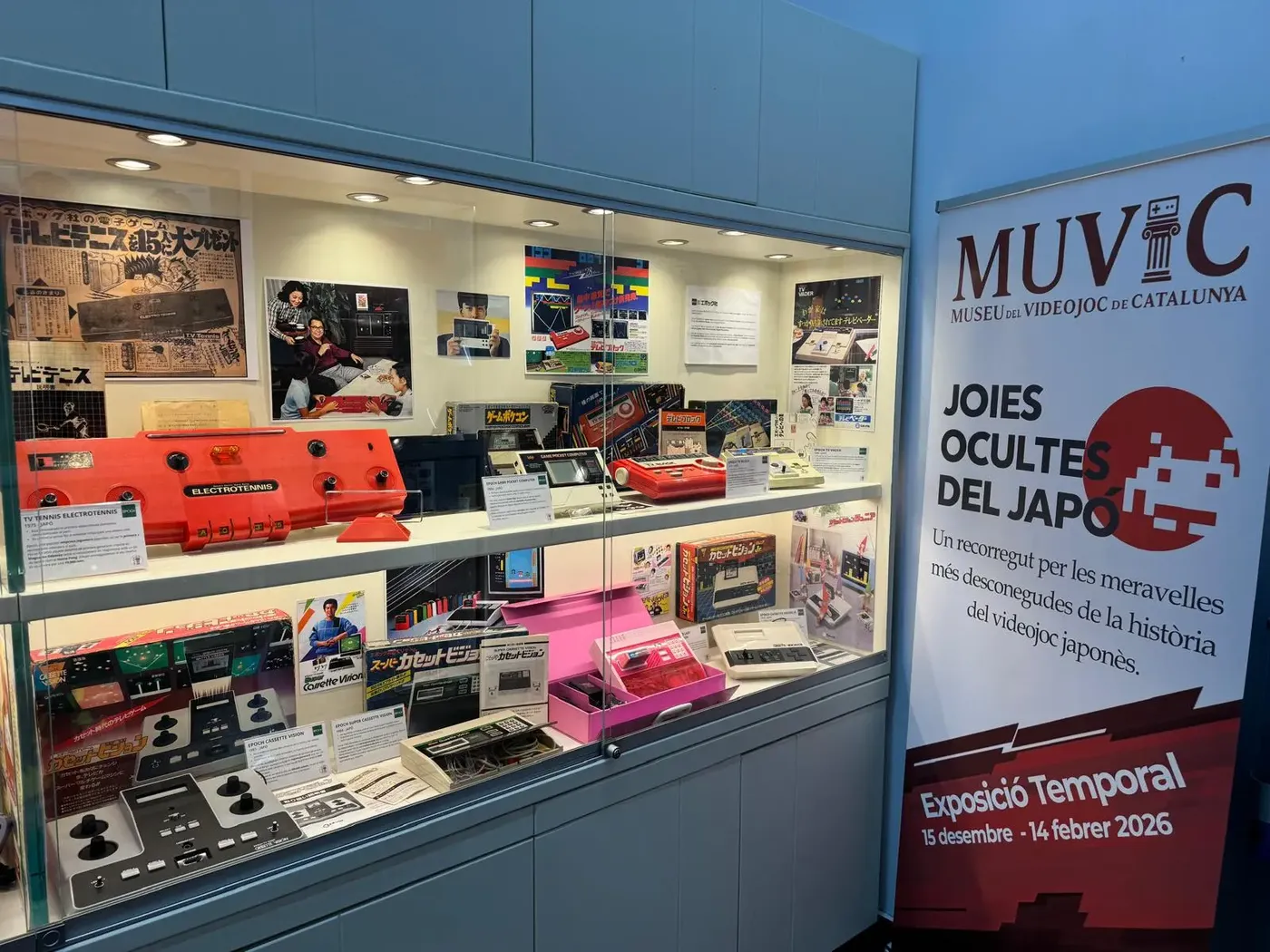
In June it took part in the first European Arcade Heritage Day, celebrating the heritage of arcade machines. The initiative grew out of the European Pixel League, driven by the association El Gat de Vader; the Figueres event was organised by the Museu del Joguet de Catalunya, with MUVIC taking part as one of the organisations in the European network. And in October it took a selection of Japanese computers, consoles and software from its collection to the UOC, at an event with Toshinari Oka as guest.
Three days at SAGA
At SAGA Barcelona Game Fest, MUVIC set up its museum in Espai 9, by the entrance, together with RetroBarcelona: original consoles and computers, guided tours and places to play.
It was the scene that sums up the project: parents showing their children the machine they grew up with, and kids discovering that there were many consoles before theirs. Nostalgia, shared.
Who’s behind it
- Eduard Tornero: president and head of heritage, in charge of the collection.
- Marc Rollán: curation and historical content.
- Carolina Cárdenas: documentation and exhibition curation.
- Ivan Santillana: cultural mediation, communication and community.
- Carles Garcia: institutional relations.
- Omar Bádenas: MUVIC’s host at SuperBoniato Store.
How to help
You can help by donating material, lending pieces on deposit (ownership doesn’t change and they can be taken back at any time), volunteering, or with money for restoration, display cases and transport. It all goes through info@muvic.cat.
Interview: Eduard Tornero
Eduard Tornero is MUVIC’s president and head of heritage. We asked him five questions, with nostalgia as the thread.
At every MUVIC exhibition there are parents finding their first console again and children discovering it. What are we really looking for when we go back to a machine from our childhood?
Deep down, I think we’re looking to reconnect with a part of ourselves. A console isn’t just a machine: it’s the afternoons playing with your brothers and sisters, your friends, the first discoveries and the emotions of a time we remember very fondly. When we switch that console on again, all those memories come back.
And when we can share them with our children, nostalgia becomes an experience shared between generations. It’s one of the most beautiful things we get to see at MUVIC.
What was your first machine? And when did you go from playing to keeping?
My first machines were a ZX Spectrum 48K and a Sega Master System. With them I discovered a world that has fascinated me all my life. In fact, I’ve never stopped playing!
The move into collecting was gradual. Over the years I became interested not only in the games but in the history of the machines, how they evolved and the people who made them. Little by little, that hobby turned into a wish to preserve and share this heritage.
The Overkal, a console made here in the seventies, is almost a secret. What did you feel the first time you had one in front of you?
It was a very special moment. I’d been looking for an Overkal for many years; it’s an extraordinarily hard piece to find. In the end, quite unexpectedly, I tracked one down at an auction house that specialises in stamps and coins! After searching for so long, finding it somewhere so unlikely was a huge thrill.
And it isn’t just any console: it’s a key piece in the early history of video games in Catalonia. Being able to add it to the collection and share it with the public is a real privilege.
Why should we look after video games as culture? What is lost when a game can no longer be played?
Video games are one of the most important cultural forms of recent decades. They combine technology, art, music, storytelling and design, and they have shaped the lives of several generations. Preserving them means keeping part of our history.
But unlike other art forms, video games need to be played to be fully experienced. When a game stops working, we don’t just lose an object: we lose the chance to live the experience it was made for. That’s why it matters so much to keep the machines and keep them running.
If tomorrow you could save only one piece from the collection, which would it be and what’s the story behind it?
I’d save an American Street Fighter cartridge for the Super Nintendo. That may be surprising, because there are much rarer and more valuable pieces in the collection, but it’s the one I had as a kid. My parents bought it for me at a real financial stretch, at a time when things weren’t easy at home.
I remember perfectly how excited I was and the wonderful times I spent playing it with my brothers and sisters. To me, that cartridge is priceless. It isn’t just a video game: it’s a reminder of my parents’ generosity and of some of the happiest moments of my childhood.
Select screen
- Cartridge or disc?
- Cartridge, always!
- The machine you’re most excited to switch on.
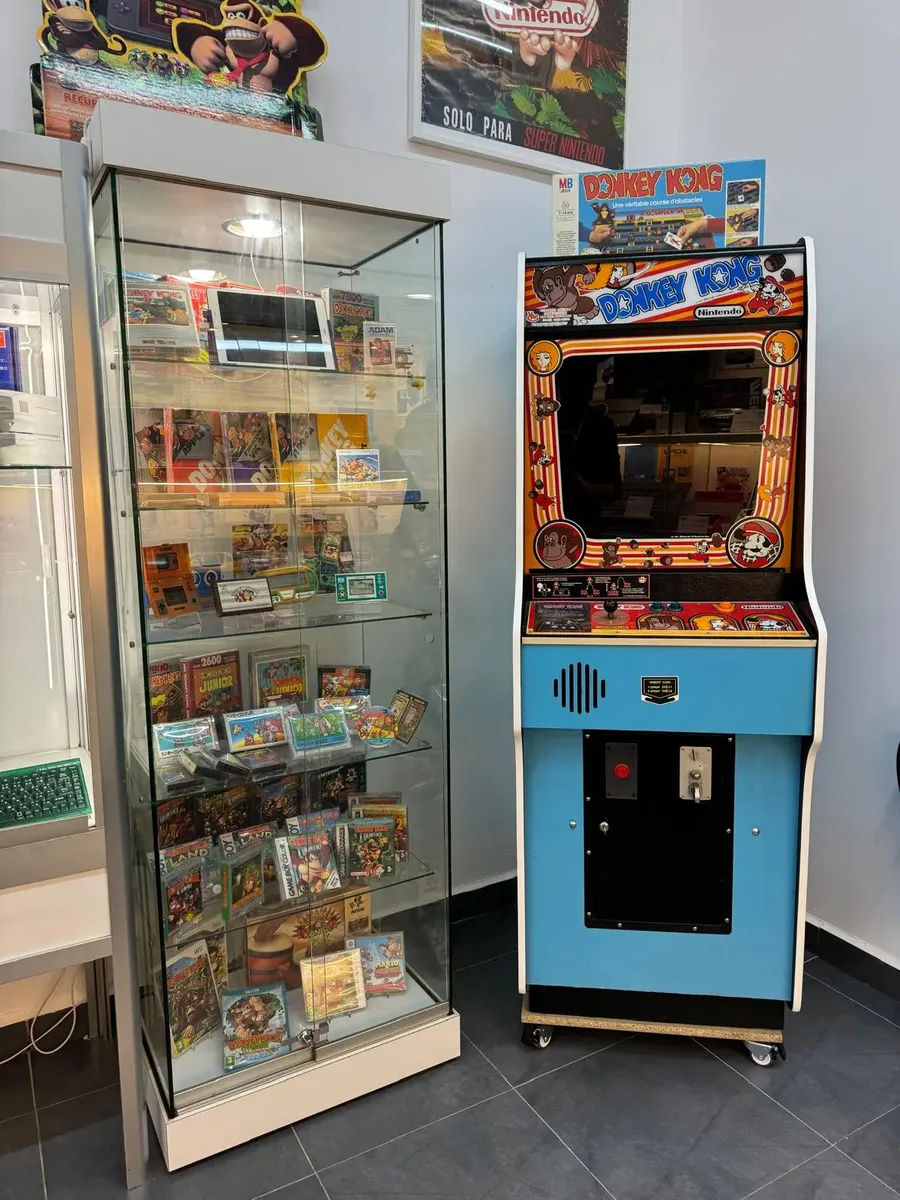
- The original Donkey Kong arcade cabinet, from 1981.
- The next piece you dream of getting.
- An NEC TK-80 from 1976.
Sources
- MUVIC · web oficial
- MUVIC · El museu, equipo y misión
- MUVIC · Actualitat
- MUVIC · Cómo colaborar
- «El SAGA Barcelona Game Fest convierte Catalunya en la capital de los videojuegos del sur de Europa» · ElNacional, 9/10/2026
- La primera consola europea se llamaba Overkal · VidaExtra
- Inter Electrónica S.A. · Wikipedia
- Overkal, the Spanish Odyssey clone · PONG-Story